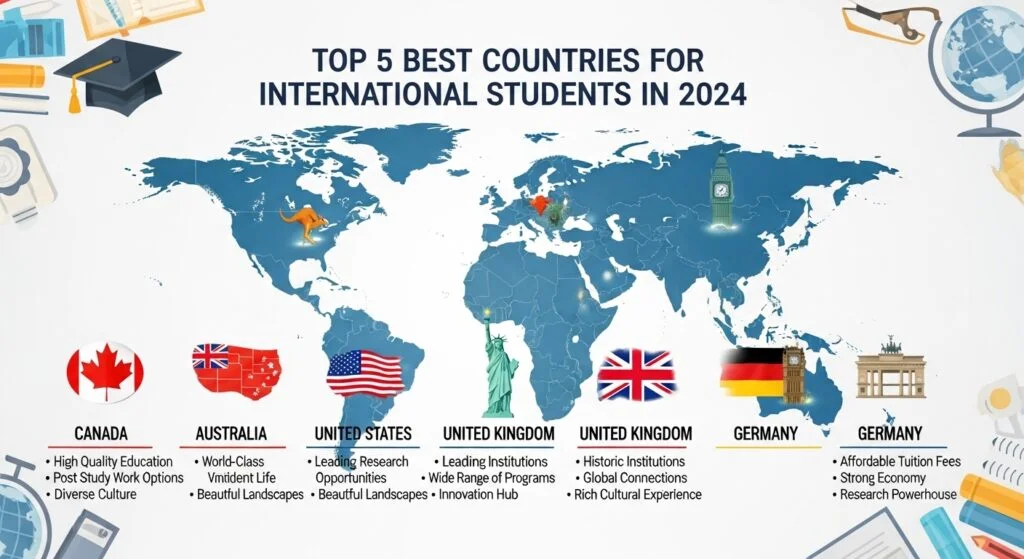
Choosing where to study is a decision that will define the next decade of your life. It is not just about the university; it is about the “Ecosystem.” Some countries offer world-class degrees but zero chance of staying to work. Others offer high wages but a cost of living that makes saving impossible. In the post-pandemic era, the landscape of global mobility has shifted. Inflation, new visa rules, and the rise of remote work have created new winners and losers. In this guide, we analyze the top countries for students in 2024, focusing on four key pillars: Academic Prestige, Post-Study Work Opportunities, Affordability, and Quality of Life. Whether you are a STEM genius or a social science visionary, there is a perfect home for your ambitions.
Our Ranking Criteria: How We Chose the Top Countries
Before revealing the top countries for students, it’s important to understand our “Scoring Logic.” We didn’t just look at university rankings (like QS or Times Higher Ed). We looked at “Student ROI.”
- Tuition-to-Wage Ratio: How long does it take to pay back your degree?
- Visa Path: How easy is it to transition from a Student Visa to Permanent Residency?
- Lifestyle: Is the country safe, inclusive, and culturally vibrant?
- Language Accessibility: Can you thrive without being a native speaker of the local tongue?
1. Germany: The Uncontested Value King
Germany remains at the top of the top countries for students list for one simple reason: Free Tuition in public universities. For the price of a local administrative fee ($300/semester), you get an education that would cost $50,000 in the US. Furthermore, Germany’s industrial base (Automotive, Engineering, Pharma) is desperate for international talent. With a 1.5-year job-seeker visa and a path to citizenship recently shortened to 5 years, Germany is the best destination for students who prioritize long-term stability over “Big Name” American prestige.
2. Canada: The Premier Pathway to Permanent Residency
While Canada has recently introduced caps on international student numbers, it remains one of the top countries for students because of its “Post-Graduation Work Permit” (PGWP). Unlike most countries, the Canadian system is designed to turn students into citizens. If you graduate from a 2-year program, you get a 3-year work permit. This permit gives you the “Canadian Experience” points required to apply for PR through Express Entry. Despite the high cost of housing in Toronto and Vancouver, the “Social Safety Net” and the welcoming multiculturalism make Canada a top-tier choice.
3. Australia: High Wages and Sunny Skies
Australia is booming. It offers some of the highest minimum wages in the world ($23+ per hour), which means a working student can actually save money while studying. Australia’s Group of Eight (Go8) universities are consistently in the global top 50. The country has also introduced extended post-study work rights for students in high-demand fields like healthcare, engineering, and nursing. If you value a “Work-Life Balance” and want to avoid the cold winters of the Northern Hemisphere, Australia is your champion among the top countries for students.
4. The Netherlands: The English-Taught Hub of Europe
The Netherlands has more English-taught Master’s programs than any other non-English speaking country. It is the perfect “Middle Ground” for students who want European affordability but aren’t ready to learn German or French. Dutch universities (like TU Delft and UvA) are world leaders in Logistics, Water Management, and Tech. The “Orientation Year” visa allows you to stay and work for any employer after graduation. The only catch? A severe housing shortage in major cities. Book your room six months in advance.
5. The USA: The Prestige & High-Earner Powerhouse
The USA remains the goal for those who want to be at the “Cutting Edge.” If you want to work at Google, Goldman Sachs, or SpaceX, you need a US degree. While tuition is high, the “Ceiling” for earnings is also the highest on Earth. A software engineer in New York or San Francisco can earn 3x what they would earn in Europe. Furthermore, for STEM students, the OPT (Optional Practical Training) extension allows you to work for up to 3 years after graduation. The USA is high-risk, high-reward, but it remains the most prestigious of the top countries for students.
Honorable Mentions: Ireland and Japan
Ireland is becoming the “New UK” for students who want to stay in the EU while speaking English. It is a hub for European HQ of American tech companies. Japan, on the other hand, is aggressively recruiting international students to solve its aging population crisis. With the MEXT scholarship and a high quality of life, Japan is a fantastic niche choice for those willing to learn the language.
The “Big Decision”: Which One is for YOU?
The top countries for students are not “One-Size-Fits-All.”
- Choose Germany if you have low savings and want to study STEM.
- Choose Canada if your primary goal is immigration and citizenship.
- Choose the USA if you want maximum prestige and are aiming for top-tier salary levels.
- Choose the Netherlands if you want a high-tech European lifestyle entirely in English.
Conclusion
The world is more accessible than ever, but the “Golden Ticket” of international education requires careful geographic selection. By prioritizing ROI, visa stability, and lifestyle, you can choose a country that doesn’t just give you a degree, but gives you a new life. Every country on this list of top countries for students has its pros and cons. Do your research, talk to current students, and match the country’s needs with your talents. Whether you are drinking coffee in a Berlin café or surfing after class in Sydney, your international journey starts with a single choice. Choose the one that feels like home. The global future is yours for the taking.
Frequently Asked Questions
Which country is the cheapest for international students?
Germany. Public universities have zero tuition fees, and the cost of living in cities like Leipzig or Dresden is much lower than in the US or UK.
Which country is best for permanent residency (PR)?
Canada and Australia have the most points-based and student-friendly immigration systems in the world.
Is the UK still a top destination?
While the UK has world-class universities (Oxford/LSE), recent visa changes (restricting family members and increasing salary thresholds) have made it less attractive for some students compared to 2023.
Can I study in these countries without the local language?
In the Netherlands, yes—it’s almost 100% possible. In Germany and France, it’s possible for Master’s degrees, but you’ll need the language for a part-time job.
What is the “Post-Graduation Work Permit”?
It is a special visa that allows you to stay and work in the country where you studied for 1 to 3 years without needing a formal employer sponsorship immediately.