You have made it to the final stage: the interview. This is where the scholarship committee decides if the person they saw on paper matches the person sitting in front of them. Most scholarship interviews are “Behavioral.” They don’t want to hear what you *would* do; they want to hear what you *did*. To answer these questions effectively, you need a framework that is logical, concise, and result-oriented. Mastering the STAR method for scholarship interview is the best way to turn a vague question into a winning story. In this guide, we will deconstruct the STAR technique and show you how to apply it to the most common (and difficult) scholarship interview questions.
The Psychology of Behavioral Interviews
Scholarship donors are risk-averse. They are investing thousands of dollars in a stranger. The best predictor of your future behavior is your past behavior. When they ask “Tell me about a time you failed,” they aren’t looking for the failure; they are looking for the recovery. The STAR method for scholarship interview ensures that you don’t ramble. It forces you to provide “Context,” “Action,” and “Evidence” in a way that proves you have the character traits they are looking for: resilience, leadership, and ethical integrity.
Breaking Down the STAR Method
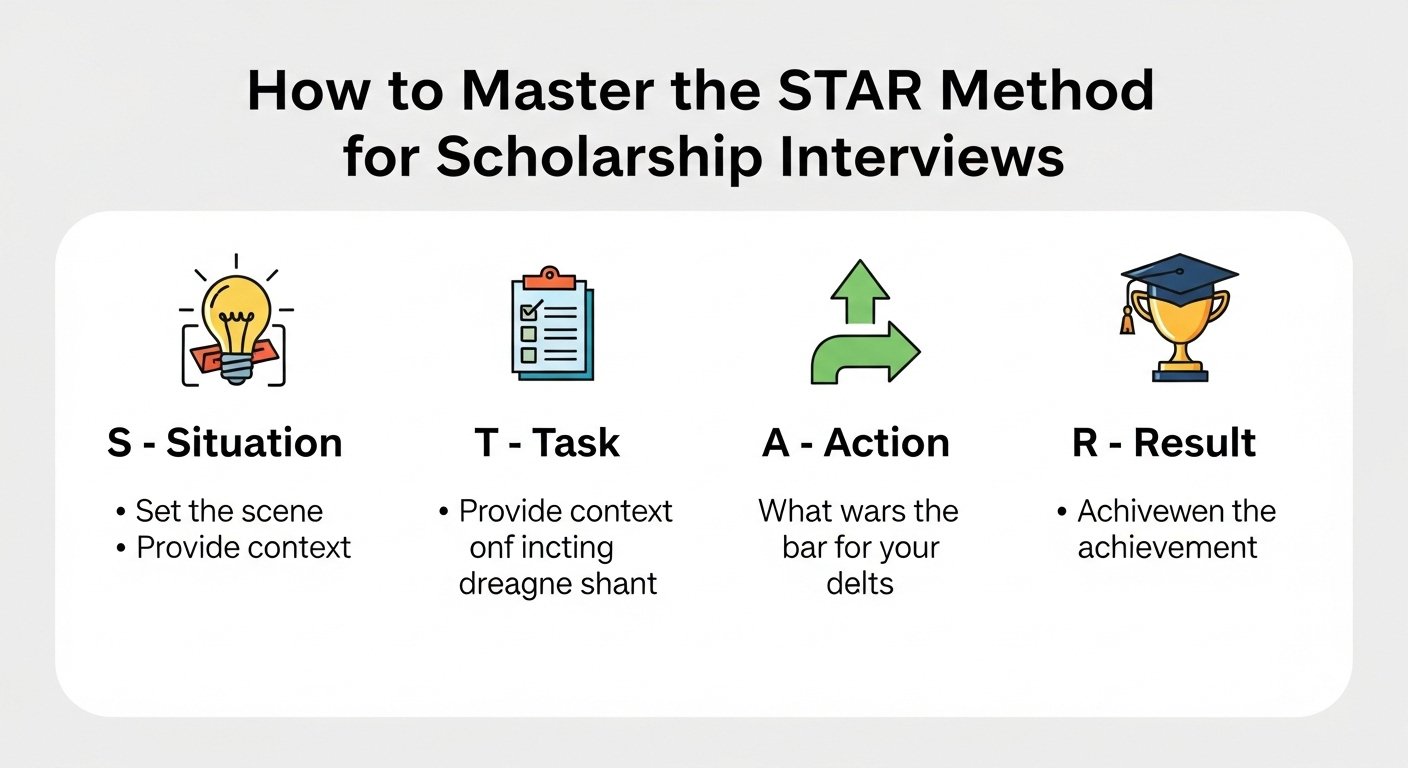
To use the STAR method for scholarship interview, you must structure your answer into four distinct parts:
- S – Situation: Set the scene. Give the necessary background in 1-2 sentences. “Last year, during my final semester, I was the head of the student science fair.”
- T – Task: What was the specific challenge? “The fair lost 50% of its funding two weeks before the event due to a sponsor pulling out.”
- A – Action: This is the most important part. What did *YOU* do? Avoid saying “We.” Focus on your specific contribution. “I personally contacted 20 local business owners and drafted a new sponsorship proposal highlighting our community reach.”
- R – Result: What was the outcome? Use numbers if possible. “I secured €3,000 in new funding in 10 days, allowing the fair to host 500 visitors and win a regional award.”
Why Donors Love Results
Most students forget the “R” in the STAR method for scholarship interview. They talk about the problem and the work, but they don’t talk about the win. Donors are looking for “Impact.” A leader who doesn’t achieve results is not a leader they want to fund. Always end your story with a positive, measurable outcome. Even if the result was a failure, the “Result” should be the “Lesson Learned.” “The result was that I learned how to manage tight deadlines and improved my negotiation skills for the next project.”
Common Behavioral Questions and STAR Answers
Prepare at least 5-7 STAR stories that can be adapted to different questions.
- “Tell me about a time you showed leadership.” (Focus on taking initiative).
- “Describe a conflict you had with a team member.” (Focus on empathy and resolution).
- “Give an example of a time you handled a high-pressure situation.” (Focus on organization and calm).
The STAR method for scholarship interview gives you the confidence to answer these without stuttering, because you are just telling a true story with a predefined beginning, middle, and end.
Avoiding the “We” Trap
International students, especially from collective cultures, often feel uncomfortable saying “I.” They say “We did this” or “Our team achieved that.” In a STAR method for scholarship interview, this is a mistake. The committee is not interviewing your team; they are interviewing you. You must take credit for your specific decisions. If you say “We,” the committee won’t know if you were the leader or just a passive observer. Be humble, but be clear about your individual agency.
Preparation Templates: Your STAR Journal
Before your interview, create a “STAR Journal.” Draw a table with four columns (S, T, A, R) and write down your top 5 achievements. Practice saying them out loud until they feel natural. Record yourself on your phone. If your “Action” section takes longer than 90 seconds, it is too long. If your “Situation” section takes more than 30 seconds, it is too long. The STAR method for scholarship interview is about “Surgical Precision.” Get in, make your point, show your result, and get out.
Conclusion
An interview is a performance, but it’s a performance based on truth. By mastering the STAR method for scholarship interview, you provide the committee with the “Data” they need to justify picking you. You prove that you are not just a dreamer, but a “Doer.” Situation, Task, Action, Result—memorize the pattern, master the stories, and walk into that room knowing that you have the evidence to back up your ambition. You have done the work; now, tell the story. The scholarship is yours to win. Good luck!
Frequently Asked Questions
Should I use the same story for different questions?
Ideally, no. It can look like you have limited experience. Try to have 5 unique stories that cover different skills (Conflict, Leadership, Failure, Success, Ethics).
What if I have never had a “Leadership” role?
Leadership isn’t a title. If you helped a younger sibling with their studies or organized a family event, those are leadership stories! Use the STAR method for scholarship interview to show the initiative you took.
Can I write down my STAR stories and bring them to the interview?
It is better to memorize them. However, bringing a small notepad with “Key Bullet Points” is usually acceptable and shows that you are prepared.
What if my “Result” was a failure?
That’s fine! Focus on the “A” (Action) and the “Lesson.” Committees respect self-awareness and the ability to learn from mistakes.
How long should each answer be?
Between 2 and 3 minutes. Any longer and you risk losing the interviewers’ attention.