Explore a complete guide to government and private scholarships for students. Learn types, eligibility, benefits, application process, and expert tips to secure financial aid for your education.
Education is one of the most powerful tools for shaping a successful future, but the rising cost of tuition, books, and living expenses can be a major challenge for students and families. Scholarships play a crucial role in reducing this financial burden by offering financial assistance based on merit, need, or specific criteria.
This comprehensive guide will help you understand everything about government and private scholarships—how they work, who can apply, and how you can increase your chances of securing one.
What Are Scholarships?
Scholarships are financial awards given to students to support their education. Unlike loans, scholarships do not need to be repaid. They are typically awarded based on:
- Academic performance
- Financial need
- Talent (sports, arts, etc.)
- Community service
- Specific categories (minority groups, gender, region, etc.)
Types of Scholarships
1. Government Scholarships
Government scholarships are funded by central or state governments. These are usually more structured and accessible to a large number of students.
Key Features:
- Often based on income criteria
- Transparent application process
- Available for school, undergraduate, postgraduate, and research levels
- Covers tuition fees, and sometimes living expenses
Examples:
- Pre-matric and post-matric scholarships
- Merit-cum-means scholarships
- Scholarships for minority students
- State-level education grants
2. Private Scholarships
Private scholarships are funded by companies, NGOs, trusts, or individuals. These scholarships often have unique eligibility criteria.
Key Features:
- May focus on specific courses or fields
- Can be merit-based or need-based
- Often fewer applicants compared to government schemes
- May include mentorship or internship opportunities
Examples:
- Corporate scholarships
- NGO-funded education programs
- Foundation-based scholarships
Government vs Private Scholarships
| Feature | Government Scholarships | Private Scholarships |
|---|---|---|
| Funding Source | Government bodies | Companies, NGOs |
| Competition | High | Moderate |
| Flexibility | Less flexible | More flexible |
| Coverage | Wide range | Often specific |
| Application | Centralized portals | Individual platforms |
Eligibility Criteria
Eligibility varies depending on the scholarship, but common requirements include:
Academic Requirements
- Minimum percentage or grade
- Entrance exam scores (if applicable)
Financial Criteria
- Family income limits
- Income certificates
Category-Based Criteria
- Reserved categories (SC/ST/OBC)
- Minority status
- Gender-specific scholarships
Course & Institution
- Must be enrolled in a recognized school/college
- Specific courses (engineering, medical, arts, etc.)
Documents Required
When applying for scholarships, you typically need:
- Aadhaar card or ID proof
- Academic certificates and mark sheets
- Income certificate
- Caste certificate (if applicable)
- Bank account details
- Passport-size photographs
- Admission proof
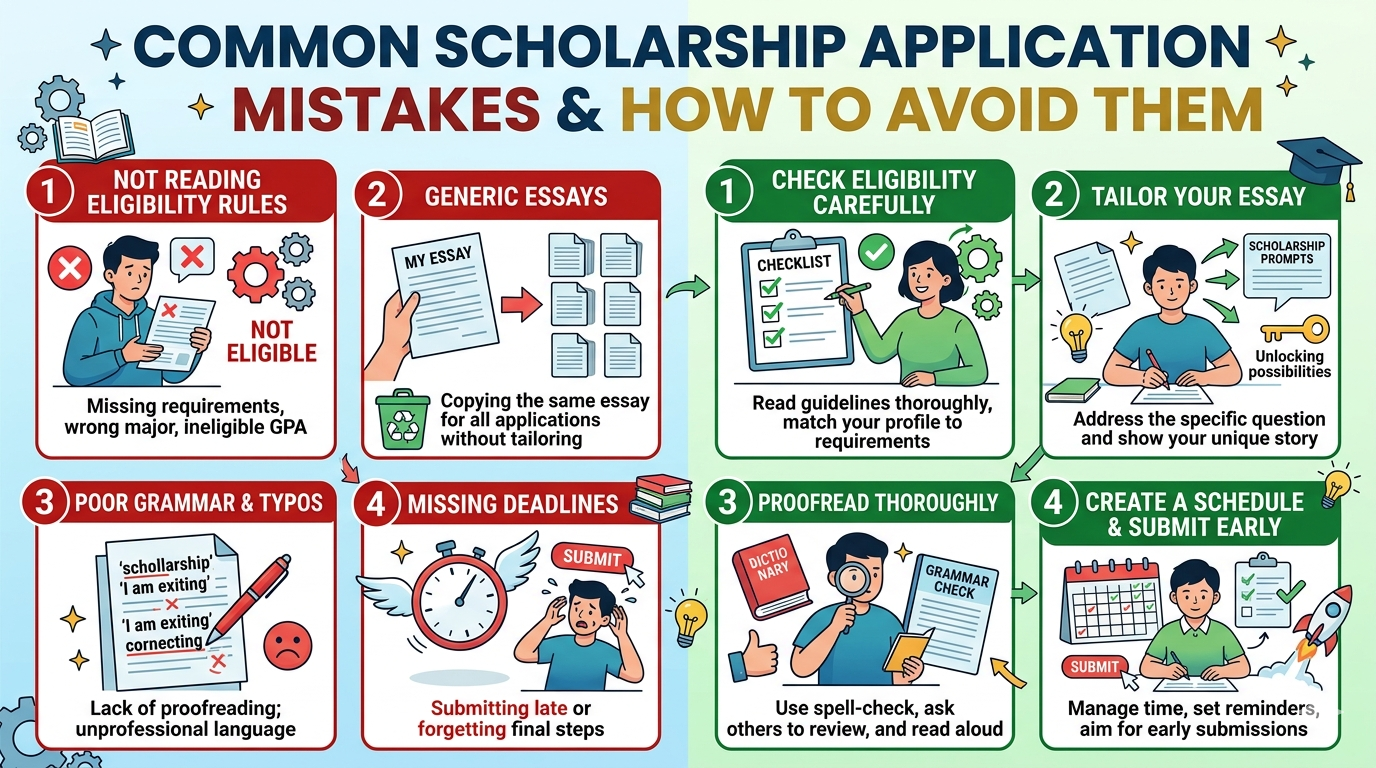
Make sure all documents are updated and accurate to avoid rejection.
How to Apply for Scholarships
Step 1: Research Scholarships
Look for scholarships that match your profile. Focus on both government and private opportunities.
Step 2: Check Eligibility
Carefully read eligibility criteria before applying.
Step 3: Prepare Documents
Keep all required documents scanned and ready.
Step 4: Fill Application Form
- Provide accurate information
- Avoid spelling errors
- Double-check details
Step 5: Submit Before Deadline
Late applications are usually rejected, so apply early.
Benefits of Scholarships
Scholarships provide more than just financial aid:
Financial Support
Covers tuition fees, books, and living expenses.
Reduced Stress
Helps students focus on studies instead of financial worries.
Recognition
Being awarded a scholarship boosts your academic profile.
Career Opportunities
Some scholarships offer internships, networking, and mentorship.
Tips to Secure a Scholarship
1. Apply Early and Widely
Don’t rely on just one scholarship. Apply to multiple opportunities.
2. Maintain Good Academic Performance
Strong grades increase your chances significantly.
3. Write a Strong Personal Statement
Explain your goals, achievements, and why you deserve the scholarship.
4. Gather Strong Recommendations
Letters from teachers or mentors can strengthen your application.
5. Stay Organized
Keep track of deadlines, documents, and requirements.
6. Avoid Common Mistakes
- Incomplete applications
- Incorrect details
- Missing deadlines
Common Challenges Students Face
Lack of Awareness
Many students miss opportunities because they are unaware of available scholarships.
Complex Application Process
Some applications require detailed documentation and effort.
High Competition
Popular scholarships receive thousands of applications.
Solution
Stay informed, prepare early, and apply strategically.
Popular Fields with Scholarships
Scholarships are available across various fields:
- Engineering and Technology
- Medical and Healthcare
- Business and Management
- Arts and Humanities
- Science and Research
Many private organizations focus on supporting students in specific industries.
Scholarships for Different Levels
School Level
- Pre-matric scholarships
- Talent-based programs
Undergraduate Level
- Merit-based scholarships
- Need-based financial aid
Postgraduate Level
- Research scholarships
- International study grants
Online Platforms to Find Scholarships
Students can explore scholarships through:
- Government portals
- Educational websites
- NGO platforms
- College notice boards
Regularly checking these sources ensures you don’t miss new opportunities.
Conclusion
Scholarships are a powerful way to make education affordable and accessible. Whether funded by the government or private organizations, they open doors for students to achieve their academic and career goals without financial barriers.
By understanding the different types of scholarships, eligibility criteria, and application strategies, you can significantly improve your chances of success. Start early, stay organized, and apply consistently. With the right approach, securing a scholarship is not just possible—it’s achievable.
FAQs
1. What is the difference between government and private scholarships?
Government scholarships are funded by the government and usually have broader eligibility, while private scholarships are funded by companies or NGOs and may have specific criteria.
2. Can I apply for multiple scholarships at the same time?
Yes, students can apply for multiple scholarships as long as they meet the eligibility criteria.
3. Do scholarships need to be repaid?
No, scholarships are financial aid that does not need to be repaid.
4. What is the most important factor in getting a scholarship?
Academic performance, along with a strong application and meeting eligibility criteria, plays a key role.
5. Are scholarships available for all courses?
Yes, scholarships are available for a wide range of courses including engineering, medical, arts, and more.